
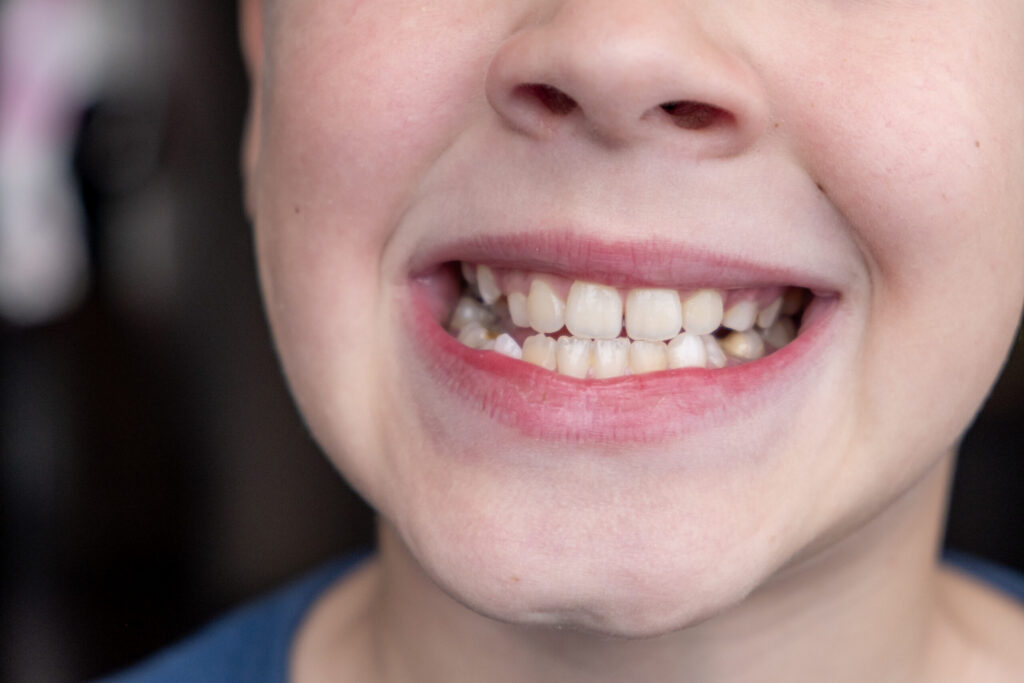
Quick answer: A crossbite in children happens when the upper and lower teeth don’t line up correctly — either at the front of the mouth or the back. It’s common, affecting roughly a quarter of school-age children in some reported estimates, and while many cases benefit from treatment, not every crossbite requires immediate correction or expansion. The right approach depends on whether the crossbite is dental or skeletal, how it’s affecting your child’s bite function, and their current stage of growth — all of which an evaluation is designed to determine.
This article is for general education and isn’t a substitute for an in-person orthodontic evaluation.
What Is a Crossbite?
A crossbite is a type of bite misalignment where one or more upper teeth sit inside the lower teeth instead of outside them, as they normally would. It can affect a single tooth, several teeth, or the entire arch, and it can occur at the front of the mouth or toward the back.
Front (Anterior) vs. Back (Posterior) Crossbite
These two patterns look different, come from different causes, and are often treated differently.
| Anterior (Front) Crossbite | Posterior (Back) Crossbite | |
|---|---|---|
| What it looks like | One or more upper front teeth sit behind the lower front teeth | Upper back teeth sit inside the lower back teeth when biting down |
| Common causes | Tooth eruption path, crowding, a retained baby tooth, sometimes a supernumerary (extra) tooth | Narrow upper jaw width, prolonged thumb-sucking or pacifier use, chronic mouth breathing |
| Typical findings | Single-tooth cases are relatively common in mixed dentition | Often involves the whole arch rather than one tooth |
| Common treatment approaches | Tongue blade therapy, a removable appliance with a spring, or a 2×4 appliance, depending on the specific case | Palatal expansion is the most common approach when the upper arch itself is narrow |
A single-tooth anterior crossbite is a particularly common and well-studied pattern — a case series on this exact presentation reported it affecting roughly 26.7% of school-age children, with minimally invasive options like tongue blade therapy sometimes sufficient for mild, cooperative cases, rather than every case requiring a more involved appliance.
Dental vs. Skeletal Crossbite: Why the Distinction Matters
This is one of the most important things an evaluation establishes, and it directly shapes which treatment path makes sense.
| Dental Crossbite | Skeletal Crossbite | |
|---|---|---|
| What’s actually misaligned | Tooth position only; the underlying jaw bones are a normal size relative to each other | A genuine size or width discrepancy between the upper and lower jaw |
| Common causes | Crowding, tooth eruption path, localized habits | Genetics, jaw growth pattern, longstanding airway or breathing-related habits |
| Typical treatment | Braces, aligners, or a limited appliance targeting the specific tooth or teeth | Palatal expansion, and in more significant cases, treatment coordinated with jaw growth over time |
Research on crossbite treatment planning has specifically noted that choosing the right approach depends on the cause of the crossbite, the patient’s age, eruption stage, available space, and family circumstances — not a single standard protocol applied to every case. This is exactly why distinguishing dental from skeletal causes matters: a dental crossbite in a cooperative child may respond to a simple, limited appliance, while a true skeletal discrepancy generally calls for a different approach altogether.
Signs Worth Noticing
- A visible crossbite when your child bites down naturally
- The jaw shifting to one side before the teeth fully close
- Uneven wear on specific teeth
- Crowding or a narrow-looking upper arch
- Chronic mouth breathing or snoring
- A dentist mentioning a bite or alignment concern at a routine visit
None of these alone confirms the type of crossbite or the right treatment path — that’s what an evaluation is for.
Treatment Options: Not a One-Size-Fits-All Decision
Depending on what an evaluation finds, treatment might include a limited, targeted appliance for a single misaligned tooth; a removable appliance or 2×4 appliance for broader anterior crossbite correction; palatal expansion when the upper arch itself is narrow; or, for mild cases involving only slight misalignment, braces or clear aligners alone without expansion first. In some cases — particularly very mild presentations caught early — monitoring with a planned re-evaluation is a reasonable option rather than immediate treatment. The right path depends on whether the crossbite is dental or skeletal, how it’s affecting function, and your child’s current growth stage.
If a narrow palate specifically is part of the picture, our guide on signs your child may need a palate expander covers that decision in more depth, including when expansion is appropriate versus when monitoring makes more sense.
When an Evaluation Is Appropriate
A crossbite is one of the clearer individual signs that an orthodontic evaluation is worthwhile, but that doesn’t mean every case needs treatment the moment it’s noticed. The American Association of Orthodontists recommends a first evaluation by age 7, which allows enough time to monitor a mild case or begin treatment while growth is still responsive, without requiring an immediate decision. Our early orthodontic treatment guide covers what this first evaluation typically involves.
Questions Parents Should Ask
- Is this crossbite dental, skeletal, or both?
- Is it affecting how my child’s jaw functions, or is it primarily a positioning issue?
- Would monitoring be reasonable here, or does this specific case call for treatment now?
- If we treat now, what’s the simplest effective option for this specific presentation?
- What happens if we wait, and when would we re-evaluate?
Frequently Asked Questions
Does every crossbite need a palate expander? No. A crossbite affecting a single tooth from a dental cause may respond to a much more limited appliance. Palatal expansion is specifically indicated when the upper arch itself is narrow — an evaluation determines whether that applies to your child.
Can a crossbite correct itself without treatment? Occasionally a very mild case resolves as permanent teeth continue to come in, but this isn’t something to assume will happen. A functional crossbite that shifts the jaw to one side is less likely to self-correct and is usually a clearer case for evaluation.
What happens if a crossbite isn’t treated? This varies by case, but can include uneven tooth wear, jaw discomfort, asymmetric jaw growth over time, and more complex treatment later if the underlying cause isn’t addressed while the child is still growing.
At what age should a crossbite be evaluated? The American Association of Orthodontists recommends a first orthodontic evaluation by age 7, which allows enough time to determine whether treatment, monitoring, or no action is appropriate.
Getting Started
If you’ve noticed a crossbite in your child, or your dentist has mentioned one, a comprehensive evaluation is the best way to understand whether it’s dental or skeletal, what’s actually causing it, and whether treatment, monitoring, or another approach fits your child’s specific case. Schedule an evaluation to get a clear, individualized answer.
References
- Correction of Single-Tooth Crossbite in Children: A Report of Three Cases. PMC, National Library of Medicine. https://www.ncbi.nlm.nih.gov/pmc/articles/PMC12356245/
- Correction of Supernumerary Tooth-Associated Anterior Crossbite in Mixed Dentition Using a 2×4 Appliance. PMC, National Library of Medicine. https://www.ncbi.nlm.nih.gov/pmc/articles/PMC13451935/