Clear aligners have changed the way a lot of people think about orthodontic treatment. The idea that you can straighten your teeth without metal brackets, without visible wires, and without most of the dietary restrictions that come with traditional braces is genuinely appealing — and for the right patient, Invisalign delivers on that promise.
But Invisalign isn’t right for everyone, and the marketing around it doesn’t always make that clear. This guide cuts through the noise to give you honest, practical information about how Invisalign works, what it costs in the San Jose and Los Gatos area, how long treatment takes, and how to know whether it’s actually the right choice for your specific situation.
What Is Invisalign?
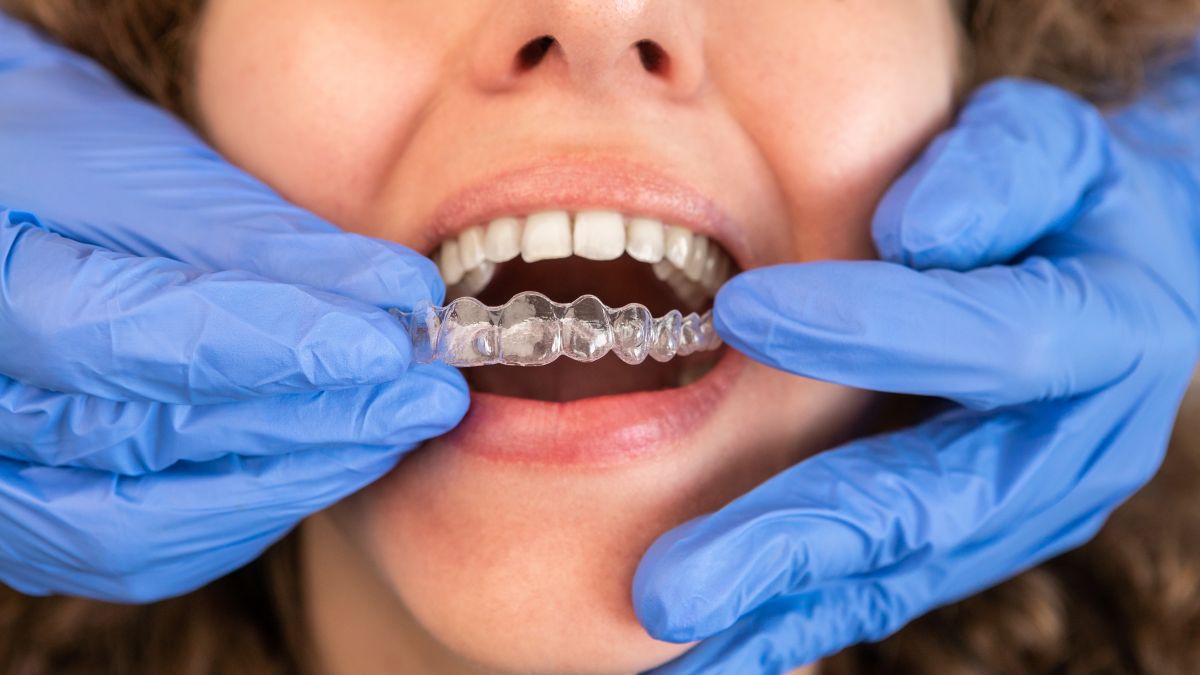
Invisalign is a clear aligner system manufactured by Align Technology. Treatment uses a series of custom-fabricated, removable plastic trays — called aligners — to gradually move the teeth from their current position to the desired final alignment. Each set of aligners is worn for one to two weeks before progressing to the next set in the series.
Because the aligners are made from a smooth, clear thermoplastic material, they’re nearly invisible when worn and far more comfortable than the metal brackets and wires of traditional braces. They can also be removed for eating, drinking anything other than water, and oral hygiene — advantages that patients, especially adults, consistently rank as the most significant benefits of the system.
How Does Invisalign Treatment Work?
The process begins with a comprehensive orthodontic evaluation. If Invisalign is a good fit for your case, your orthodontist takes a detailed 3D digital scan of your teeth — no impressions or messy putty required. That scan is used to digitally map out the full movement of your teeth from start to finish, and every set of aligners you’ll need for the entire treatment is fabricated from that plan before you even begin.
Your first set of aligners
When your aligners arrive, your orthodontist will fit them, make sure they seat correctly, and walk you through how to insert and remove them. Some patients also receive small tooth-colored attachments at this stage — more on those below. You’ll leave with several sets of trays and instructions on how to progress through them.
Check-up appointments
Unlike traditional braces, which require adjustments every four to six weeks, Invisalign check-ups are typically scheduled every six to eight weeks. At each visit, your orthodontist reviews your progress, confirms the teeth are tracking as planned, and provides the next sets of trays.
Refinements
For some patients, a refinement phase is needed toward the end of treatment — an additional set of aligners to fine-tune tooth positions that didn’t move exactly as planned. This is common and is simply part of how the process works for more complex cases. A good orthodontist will factor in the likelihood of refinements when discussing your overall treatment timeline upfront.
What Are Invisalign Attachments?
For cases that require more precise or complex tooth movement — rotations, vertical movements, root tipping — your orthodontist may bond small, tooth-colored composite bumps called attachments to certain teeth. These attachments give the aligner tray something to push against, allowing for more controlled movement than the smooth tooth surface alone would permit.
Attachments are matched to the color of your teeth and are not visible from a normal conversational distance. Up close, however, they are noticeable. This is something to be aware of if your primary motivation for choosing Invisalign over braces is aesthetics — for many patients with moderate-to-complex cases, attachments are a necessary part of treatment.
How Much Does Invisalign Cost in San Jose?
Invisalign treatment in San Jose typically ranges from approximately $3,500 to $8,000, depending on a few key factors:
The complexity and length of your case
Invisalign offers different product tiers based on the scope of treatment needed. Invisalign Lite — designed for minor corrections involving limited tooth movement — sits at the lower end of the cost range. Comprehensive Invisalign for full-arch treatment involving complex tooth movements or bite correction is at the higher end. Your orthodontist will recommend the appropriate product tier based on what your case actually requires.
Provider experience
Align Technology recognizes providers at different tiers based on their volume of Invisalign cases. More experienced providers have treated more cases and have a stronger track record with complex situations. When comparing quotes, it’s worth asking about the provider’s level of Invisalign experience, not just the price.
Insurance coverage
Most dental insurance plans that include an orthodontic benefit apply that benefit equally to Invisalign and traditional braces — the system doesn’t affect eligibility. If your plan has a $1,500 or $2,000 orthodontic lifetime maximum, that applies to Invisalign just as it would to braces. It’s worth confirming your coverage before your consultation so you have an accurate picture of your out-of-pocket cost.
Payment and financing
We offer flexible payment options to make treatment accessible without requiring full payment upfront. Visit our financial information page to learn about our payment plans and accepted insurance. For a broader look at how orthodontic costs are structured in our area, see our guide: How Much Do Braces Cost in San Jose?
How Long Does Invisalign Take?
Treatment length varies considerably depending on how much tooth movement is needed. Here’s a general range to set expectations:
Minor corrections (Invisalign Lite)
Cases involving limited crowding, slight spacing, or minor relapse after previous orthodontic treatment can often be completed in 6 to 9 months.
Moderate cases
Most comprehensive Invisalign cases fall in the 12 to 18 month range. This covers the majority of adults and teens seeking treatment for moderate crowding, spacing, or bite correction.
Complex cases
More involved cases — significant bite correction, complex rotation, or cases requiring considerable vertical tooth movement — may take 18 to 24 months or longer. For very complex bite issues, braces may still offer more precise control than aligners, and your orthodontist should be honest with you about that if it applies to your case.
The compliance factor
Invisalign timelines are uniquely sensitive to patient behavior in a way that braces timelines are not. With braces, the appliance works continuously whether you think about it or not. With Invisalign, the aligners only work while they’re in your mouth — and they need to be worn 20 to 22 hours per day to stay on schedule. Patients who consistently hit that threshold get the results the treatment promises. Those who wear their aligners 14 or 15 hours a day typically fall behind their projected timeline, sometimes significantly.
Invisalign vs. Braces: How to Decide
Both systems can produce excellent outcomes for the right patient. The decision between Invisalign and braces comes down to a combination of clinical factors and personal priorities:
Invisalign tends to be the better fit when:
You’re an adult or a responsible teen who will realistically commit to 20 to 22 hours of daily wear. Your case involves mild to moderate crowding, spacing, or bite issues that fall within what aligners can reliably correct. Aesthetics and discretion during treatment are important to you. You value the ability to remove your appliance for special occasions, photos, or specific activities. Good oral hygiene is a priority — Invisalign makes brushing and flossing much easier than braces.
Braces may be a better choice when:
Your case involves complex bite correction, significant vertical tooth movement, or other issues that respond better to the more precise, three-dimensional control that fixed appliances offer. You’re treating a child or a teen who is unlikely to wear removable aligners consistently. You’d prefer a set-it-and-forget-it treatment experience where the appliance works without relying on your daily habits. You want the most cost-effective comprehensive treatment option.
The most important thing is getting an honest evaluation from an orthodontist who is genuinely trying to recommend the best treatment for your situation — not just the treatment that’s easiest to sell. Both options are available at Phelps Cohen Orthodontics, and we’ll give you our honest clinical recommendation based on what your teeth actually need. You can also explore how our orthodontic treatments compare.
Is Invisalign Right for Teens?
Invisalign Teen is a version of the system specifically designed for adolescent patients. It includes a few features tailored to the realities of treating teenagers:
Compliance indicators
Each aligner has small blue dots that fade with wear. As the dots lighten, both the patient and parent can see at a glance whether the aligners are being worn as prescribed — a practical accountability tool.
Replacement aligners
The teen version includes several replacement aligners built into the treatment plan, acknowledging the reality that teenagers sometimes lose or damage trays.
Accommodations for still-erupting teeth
The Invisalign Teen system is designed to accommodate permanent teeth that may still be coming in during the course of treatment, which is common for patients in the 13 to 16 age range.
The key question with teens is always compliance. Invisalign works beautifully for motivated, responsible teenagers who genuinely want straighter teeth and will take ownership of wearing their aligners consistently. For teens who are less invested in treatment or likely to lose their trays, braces often produce more predictable results — because the appliance doesn’t depend on the patient’s daily habits to do its job.
What Happens After Invisalign Treatment?
Just like with braces, completing Invisalign treatment is followed by a retention phase. Teeth will naturally drift back toward their original positions if they’re not retained — that’s simply how biology works, regardless of which orthodontic system was used to move them.
Most Invisalign patients receive a set of clear Vivera retainers (made by Align Technology, the same company that makes Invisalign) for nightly wear after treatment. Some patients are also given a fixed retainer bonded behind the front teeth for additional long-term security. Wearing your retainers as instructed is what makes your Invisalign results permanent.
Invisalign Near Me: Our Locations in San Jose & Los Gatos
Phelps Cohen Orthodontics offers Invisalign treatment at our offices throughout the South Bay. Whether you’re looking for Invisalign in Los Gatos, the Rose Garden area of San Jose, or Blossom Valley, we have a location convenient to you. See all of our office locations and find the one closest to you.
Our doctors bring the same level of expertise, attention, and care to Invisalign treatment as they do to every other service we offer. Meet our team and learn more about our approach to orthodontic care.
Get Started with a Free Invisalign Consultation in San Jose
The only way to know for certain whether Invisalign is the right path for you is to have your teeth evaluated by an experienced orthodontist. Our consultations are complimentary, no-pressure, and designed to give you the real information you need to make a confident decision.
We’ll assess your teeth and bite, discuss your goals and lifestyle, review your treatment options honestly, and give you a clear picture of what Invisalign would involve for your specific case — including realistic timelines and costs before you commit to anything.
Request your free consultation online and let’s find out if Invisalign is the right move for your smile.